 Skip-the-line available
 What to See in the Royal Necropolis of Saint-Denis
A walk through the paid visit — Suger's Gothic choir, the royal tombs, the crypt and the Fabrique de la flèche spire workshop.
The paid visit to Saint-Denis takes you beyond the free nave into the Royal Necropolis — and packs an astonishing amount into a compact route: the birthplace of Gothic light, a thousand years of royal tombs, a solemn crypt, and a working yard where a lost spire is being rebuilt by hand. This guide walks you through what you will see and in what order, so you know where the highlights lie and give each its due.
Suger's Gothic Choir and Ambulatory
The architectural heart of the visit is the choir and ambulatory that Abbot Suger raised around 1140 and had consecrated in 1144 — the first coherent Gothic ensemble in the world. Here, ribbed vaults and pointed arches carry the roof on slender supports, freeing the outer wall into a continuous ring of chapels glazed with coloured glass. Suger wanted light as a reflection of the divine, and standing in the ambulatory as it pours through the windows, you can see exactly what he achieved.
This is where every Gothic cathedral that followed — Chartres, Notre-Dame, Reims — looks back to, so take a moment to appreciate that you are at the source. Look up at the vaults, walk the ring of chapels, and notice how the structure seems to dissolve into glass and light. It is the single most important space in the history of Gothic architecture.
The Royal Tombs and Gisants
Filling the choir and transept are the royal tombs — the largest collection of royal funerary sculpture in Europe. At the lower level lie the medieval gisants, recumbent effigies of the kings and queens carved in prayer, many commissioned in the 13th century to memorialise earlier monarchs. Above them rise the great Renaissance monuments: Louis XII and Anne of Brittany, François I and Claude de France, Henri II and Catherine de' Medici — white-marble temples that are masterpieces of French sculpture.
Take time to move among them, reading the crowns, the heraldry and the animals at the effigies' feet, and comparing the serene medieval style with the drama of the Renaissance tombs, which show their subjects both in prayer and as cadavers. This gathering of a thousand years of royalty in one choir is what makes Saint-Denis unique among the churches of France.
The Crypt
Descend into the crypt beneath the choir — the oldest and most solemn part of the church. Among simple black-marble tombs rest the remains of Louis XVI and Marie-Antoinette, brought back to Saint-Denis after the Restoration, and an ossuary holds the bones gathered after the royal tombs were desecrated during the Revolution in 1793. After the splendour of the choir above, the crypt is deliberately quiet and sombre.
It is here that the necropolis feels most like a real burial place rather than a museum, and for many visitors it is the emotional heart of the visit — the point where the whole arc of the French monarchy, from Suger's kings to the guillotine, comes together in a few metres of stone. The crypt is reached by stairs, so bear that in mind if you have mobility concerns.
The Fabrique de la Flèche
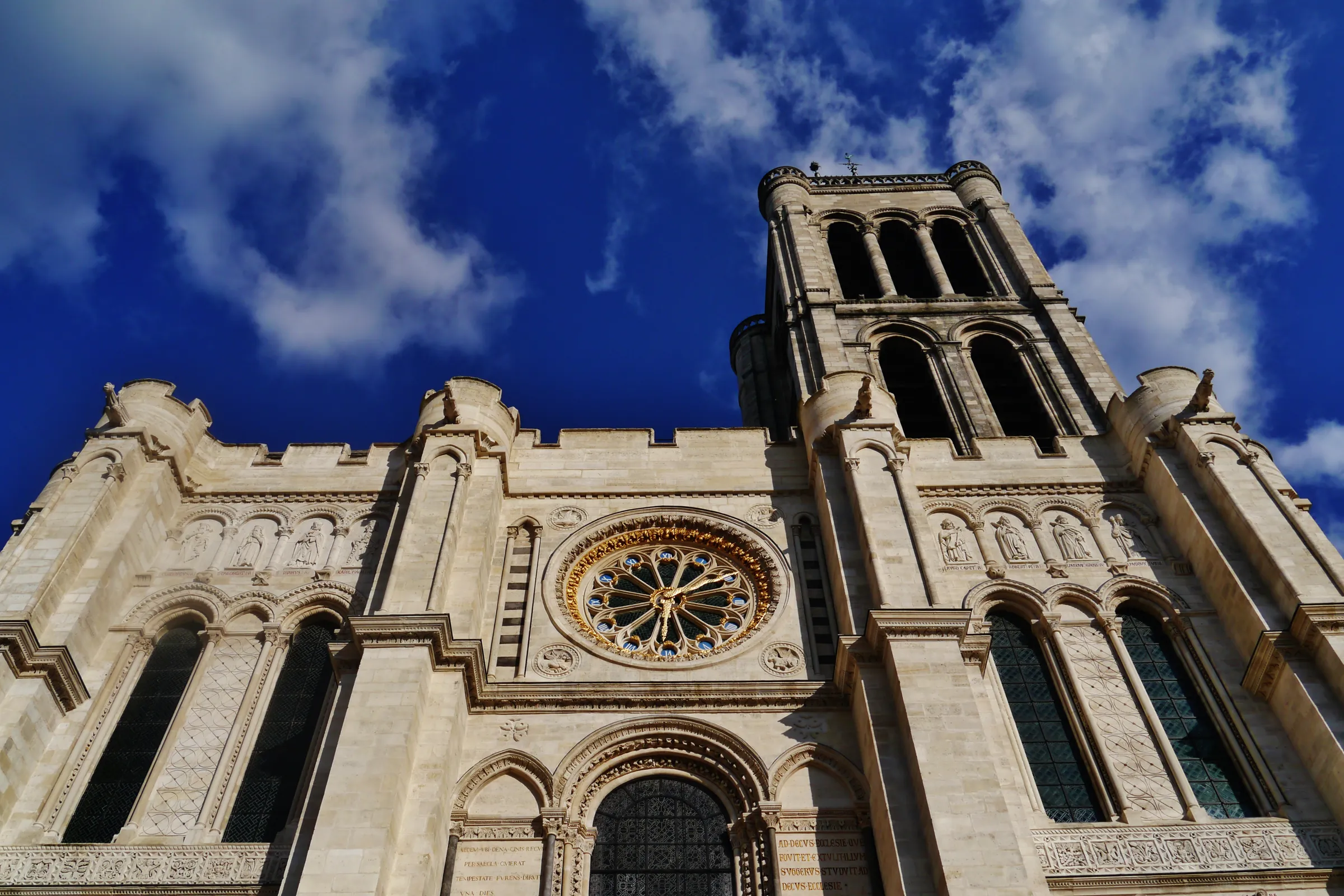
The visit also includes the Fabrique de la flèche — the working yard where craftsmen are rebuilding the basilica's north tower and its 86-metre spire, dismantled in the 19th century, using authentic medieval building techniques. It is a rare and wonderful thing: a chance to watch a great Gothic spire rise stone by stone, as it would have done 800 years ago, complete with the tools, the workshop and the craft of medieval builders.
For many visitors, and especially for children, this living construction site is an unexpected highlight — proof that Saint-Denis is not a monument frozen in the past but a place where medieval architecture is still being made. One thing to note: the Fabrique de la flèche is closed on Mondays, though the rest of the necropolis stays open, so choose another day if the spire workshop is a priority.
Frequently asked
What does the paid visit include?
The Royal Necropolis: Abbot Suger's Gothic choir and ambulatory, the royal tombs and gisants, the medieval crypt, and the Fabrique de la flèche spire workshop. The nave of the basilica is free and separate.
What is the most important thing to see?
Architecturally, Suger's choir — the birthplace of Gothic. Historically, the royal tombs and gisants, the largest collection of royal funerary sculpture in Europe. Most visitors also find the crypt and the Fabrique de la flèche memorable.
How long is the route?
Most visitors take between an hour and an hour and a half. It is self-paced, so you can linger in the choir and among the tombs, and go down into the crypt at your own pace.
Is the Fabrique de la flèche always open?
It is included in the visit but closed on Mondays, while the rest of the Royal Necropolis stays open. If watching the spire being rebuilt matters to you, choose any day but Monday.
Is the crypt part of the visit?
Yes — the crypt, with the tombs of Louis XVI and Marie-Antoinette, is included in the Royal Necropolis ticket. It is reached by stairs, so allow for that if you have mobility concerns.
Is it suitable for children?
Yes — the tombs, effigies and the thousand-year story of kings and queens capture children's imagination, and the Fabrique de la flèche, where a spire is being rebuilt by hand, is a highlight. Remember it is closed on Mondays.