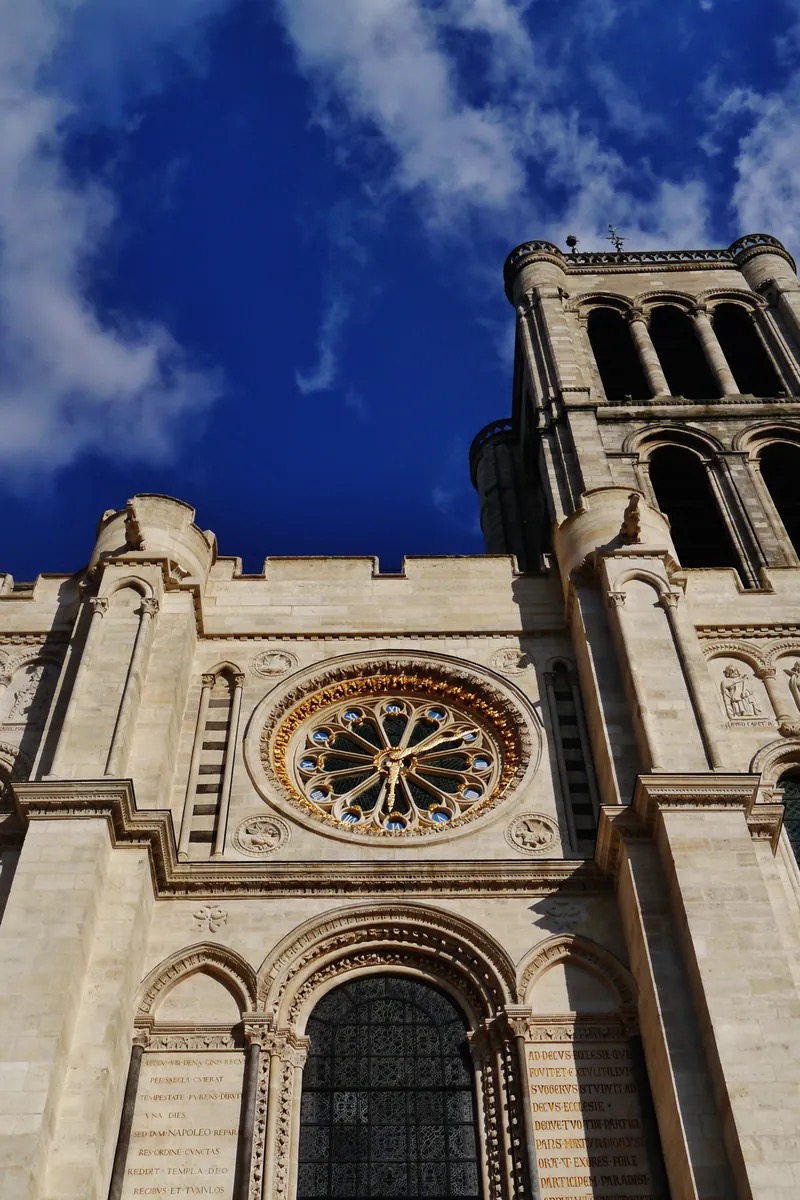
The Basilica of Saint-Denis, just north of Paris, is two extraordinary things at once. It is the birthplace of Gothic architecture — the place where, around 1140, Abbot Suger raised a new kind of choir consecrated in 1144, dissolving heavy Romanesque walls into ribbed vaults, pointed arches and a ring of radiating chapels flooded with coloured light. Suger dreamed of a church that would 'shine with the wonderful and uninterrupted light of most luminous windows', and in doing so he invented the style that would spread from here to Chartres, Notre-Dame and the great cathedrals of Europe.
It is also the royal necropolis of France — the burial place of the kings and queens of the realm for more than twelve centuries. Almost every French monarch from the 10th century until the Revolution was laid to rest here, and the choir and ambulatory hold the largest collection of recumbent funerary effigies, the gisants, anywhere in Europe. Among them stand the soaring Renaissance tombs of Louis XII and Anne of Brittany, of François I and Claude de France, and of Henri II and Catherine de' Medici — white-marble monuments that are masterpieces of French sculpture in their own right, above a crypt that holds the remains of Louis XVI and Marie-Antoinette.
Today the nave of the basilica remains a living place of worship, free and open to all. The paid visit is to the Royal Necropolis beyond it — the choir, the ambulatory, the crypt and the incomparable gathering of royal tombs — together with the Fabrique de la flèche, the on-site workshop where craftsmen are rebuilding the basilica's lost spire using medieval techniques. It is one of the most moving and least crowded historic visits within reach of central Paris: the cradle of Gothic light and the sleeping company of a thousand years of French royalty, a short Métro ride from the city.